ehs investment case

EHS & sustainability investment case

How to build the business case for EHS software – and get leadership to say yes

12 minuteslast update: 24/08/2026

You already know EHS matters. The challenge is proving it – in financial language that gets leadership to release budget. This article walks you through a practical framework for building that case, from defining your current costs to calculating the return on investment of a digital EHS solution.

Step 1: Define what your current approach is costing you

Before you can make the case for investment, you need to know what the current situation is costing your organisation – in time, risk and money. The most common cost drivers are: manual data entry and duplicate reporting, slow incident resolution, audit preparation overhead, regulatory compliance gaps, and fragmented systems that prevent real-time visibility. Start by identifying which of these apply to your organisation and estimating their annual cost.

Step 2: Understand what a digital EHS solution actually does

A digital EHS platform replaces fragmented manual processes with a single connected system. Here is what that means in practice:

  • Health & Safety: risk assessments, incident reporting, online safety instructions and qualifications in one place.
  • Risk & Audit Management: structured audit programmes, corrective actions and external stakeholder alignment.
  • Legal Compliance: legal registers, obligation tracking and inspection management.
  • Hazardous Substances: compliant chemical management, SDS handling and dangerous goods tracking.
  • Environmental Management: waste, energy and water monitoring with integrated sustainability reporting.
  • Control of Work: permit-to-work management and LOTO safeguards.

Step 3: Quantify the value of switching

In addition to pinpointing your organization's EHS&S challenges and considering hazard classifications like those from OSHA (Biological, Chemical, Ergonomic, Physical, Safety), a key step is to evaluate the value an EHS&S solution offers through proactive hazard resolution, continuous monitoring, and early problem prevention.

Ideal “To-Be” Scenario: 

The value of a digital EHS solution comes from two sources: the costs it eliminates (incidents, manual admin, audit overhead, fines) and the costs it reduces (insurance premiums, staff time, inventory buffers). Your business case needs to quantify both. 

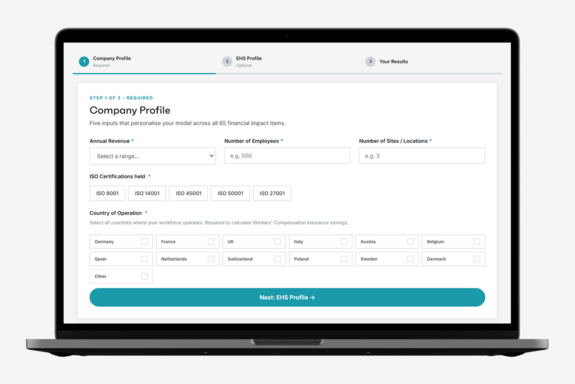
Start with the Quentic ROI Calculator to generate an estimated annual savings figure based on your own organisation's size, certifications and operational profile. Use that figure as the starting point for your 'Expected Savings' in Table A below.


Generate your expected savings figure 

Input your revenue, headcount, sites and certifications. The ROI Calculator estimates your annual savings across 65 line items – including staff time, audit costs, incident risk, insurance premiums and more. 

Calculate my savings


Factual “As-is” Scenario:

In addition to evaluating the new solution's cost, a comprehensive understanding of the financial consequences of the current situation is essential. Just as value drivers are organization-specific, so too are the financial aspects of EHS&S management. 

To complete your business case, you also need to quantify what your current approach is costing you – not just in software licences, but in staff time, manual admin, compliance risk and incident-related downtime. These are often invisible costs that don't appear on any budget line until you add them up. 

Use the list below as a starting point for your Current Solution Costs in row ii of Table A:

  • Cost of current EHS software licences (if any) 
  • Staff time spent on manual data entry and duplicate reporting 
  • Audit preparation and documentation time 
  • Incident investigation and resolution time 
  • Regulatory compliance monitoring and reporting 
  • Training administration 
  • Any fines or penalties incurred in the last 3 years 

Step 4: Run the financial analysis

Once you have your Expected Savings and New Solution Cost figures, the financial analysis follows a straightforward four-step process:

  • Cash flow projection: map your costs and savings across five years (Year 0 = implementation cost; Years 1–5 = annual net savings).
  • Net Present Value (NPV): apply your organisation's cost of capital to the projected cash flows to determine total long-term value. The downloadable template includes the formula.
  • Payback Period: how many months until the investment pays for itself. Most EHS digital transformations achieve payback within 12–24 months.
  • Return on Investment (ROI): total net savings over five years divided by total project cost, expressed as a percentage.

Download the PDF template here:

Instructions for using the template

To use the template efficiently, follow the detailed explanations below, for all template elements.

Objective of Table A above: To calculate the expected savings when your organization gets rid of current EHS&S related issues and existing legacy solution. 

i. Quantified issues: the annual cost of your current EHS challenges: incidents, downtime, non-compliance, training admin, duplicate data entry. Use historical data where available.

ii. Current solution costs: all costs of your existing approach: software licences, staff time, manual admin and spreadsheet maintenance.

iii. By adding the above costs (i + ii), the expected savings as benefits in Euros can be derived. 

Not sure of your numbers for rows i or ii? 

The Quentic ROI Calculator estimates your current EHS costs across 65 line items - based on your employee count, sites and certifications. Use it to generate a starting figure before completing the template. 

Run the ROI Calculator

Objective of Table B above: To calculate the Net pre-tax income for future years, considering the expected savings and total cost of the New EHS&S solution. 

iii. The expected savings from getting rid of the current issues and legacy solution as calculated in Table A. 

iv. The total cost of ownership of New EHS&S solution for future years (years 1 to 5). The initial cost on hardware and one-time software license fees if any need to be captured as Capex in Year 0. 

v. The annual Net Income before taxes can be derived by subtracting the new solution cost from expected savings. 

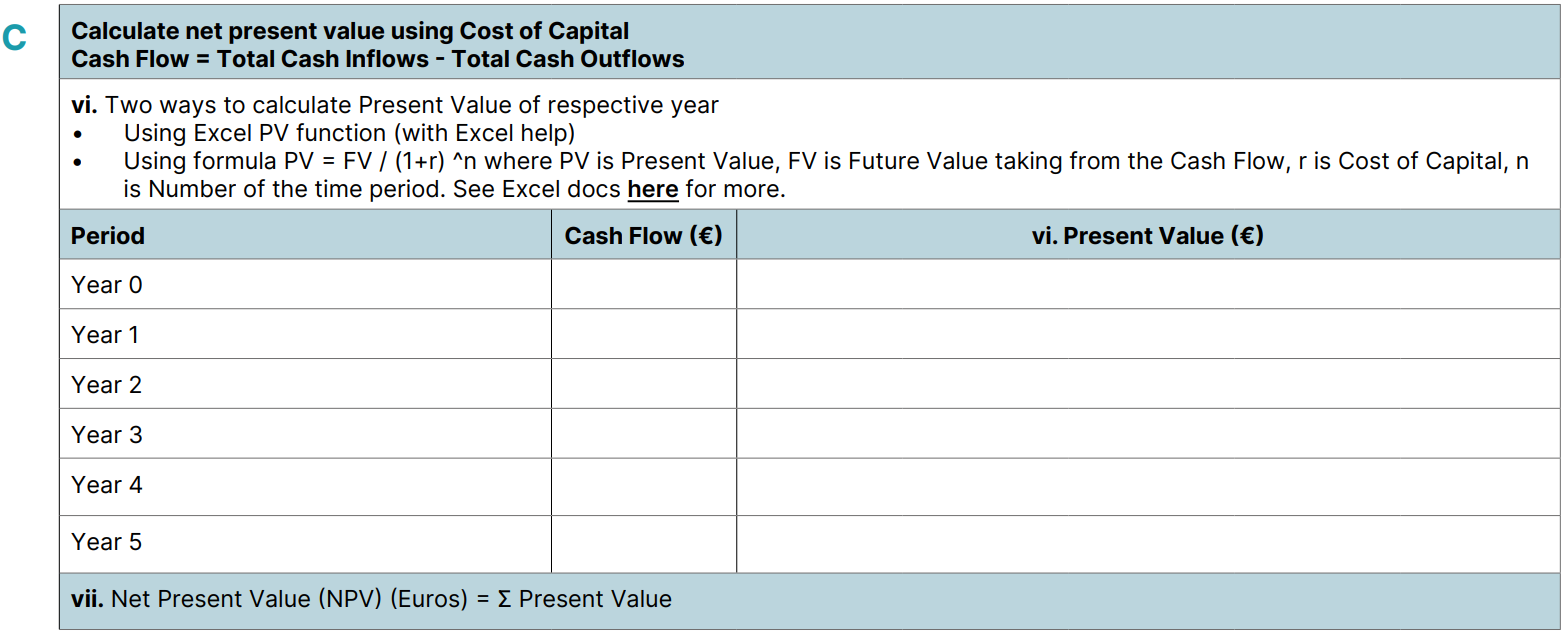
Objective of Table C above: To calculate the net present value of the project as a whole. 

vi. First determine the present value for respective years by: 

A. Filling the cash flow for years 0 to 5 in the above table. The cash flow = Annual Net pre-tax income as calculated in step v. 

B. For respective years’ cash flow, calculate the present value by either 

Using Excel PV function (with Excel help) or 

Using formula PV = FV / (1+r) ^n where PV is Present Value, FV is Future Value from the cash flow, r is Cost of Capital, n is Number of the time period 

vii. The Net Present Value of the project is sum of the present values for the whole term of 5 years. 

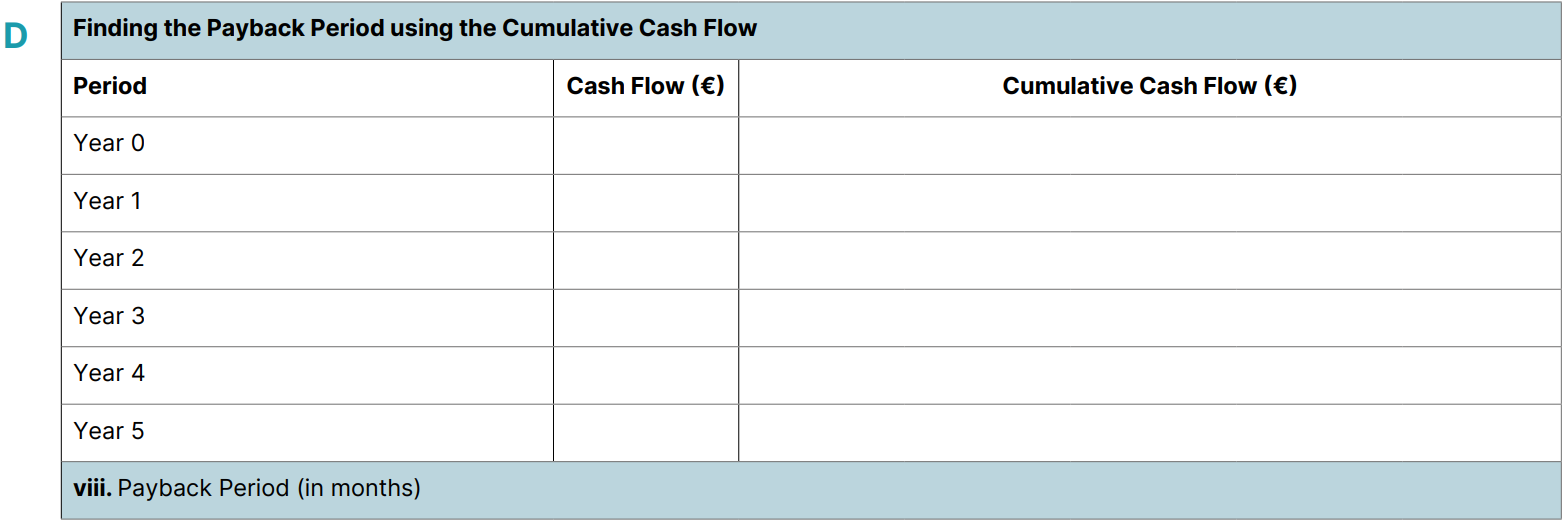
Objective of Table D above: To calculate the Payback period of the project. 

viii. The steps as follows: 

A. Fill the Present Value of cash flow for respective years as calculated  

B. Calculate the cumulative values for respective years from year 0 to 5. 

C. Payback period = (i – c)/o where 

  1. i = Initial investments in year 0 
  2. c = Cumulative present value in the year just before break-even 
  3. o = Original cash flow in the break-even year 

viii. Payback period can be represented in months or years. 

Objective of Table E above: To calculate the Return on Investment of the project. 

Steps ix. & x. is explained as above. 

In summary, applying the appropriate financial figures to the outlined templates will reveal:

  1. The Net Present Value (NPV) of your EHS&S investment, reflecting its total long-term value considering future savings and costs. 
  2. The Payback Period, indicating in months when the benefits of your EHS&S investment will begin to be realized during the project term. 
  3. The Return on Investment (ROI) percentage for your EHS&S investment over the entire project duration. 

The biggest EHS cost may be the one you haven't measured yet

Every number in this template is unique to your organisation – your incident history, your staff costs, your compliance risk profile. The framework above gives you the structure. The Quentic ROI Calculator gives you the starting figures. 

Use it to generate your personalised savings estimate across 65 EHS impact items and 7 financial categories – then bring that number into your next leadership conversation. 

Your EHS programme is already delivering value. Now put a number on it.

Generate your savings estimate in under two minutes

X