AI in EHS & sustainability management
Modern, digital-first businesses are demanding more by the day from information and data processing. This is especially true for occupational health and safety and environmental protection, which have evolving regulatory complexities. Artificial intelligence is indispensable to meeting growing requirements, managing information flows, and handling increasing time and resource pressures in day-to-day operations.
A new kind of teamwork: People & AI
Let Quentic’s EHS AI tools and agents support your sustainability programs and safety tasks. Automate routine activities: updating safety data sheets or generating in-depth analyses with our AI incident management software. Eliminate time-consuming administrative tasks and focus expertise and effort where it creates the most value. Gain more freedom for strategic initiatives, on-site engagement, and strengthening your safety culture.
Quentic is your AI‑enabled, end‑to‑end solution
AI delivers the best results when used with clear purpose and reliable, structured data. With Quentic, you achieve exactly that. Our cloud-based platform is purpose-built for comprehensive management of occupational safety, environmental management, and sustainability. With Quentic, you gain a centralized, complete, and optimized data foundation. Our AI features allow you to amplify the value of your knowledge base and data across your organization.


EHS & sustainability AI features
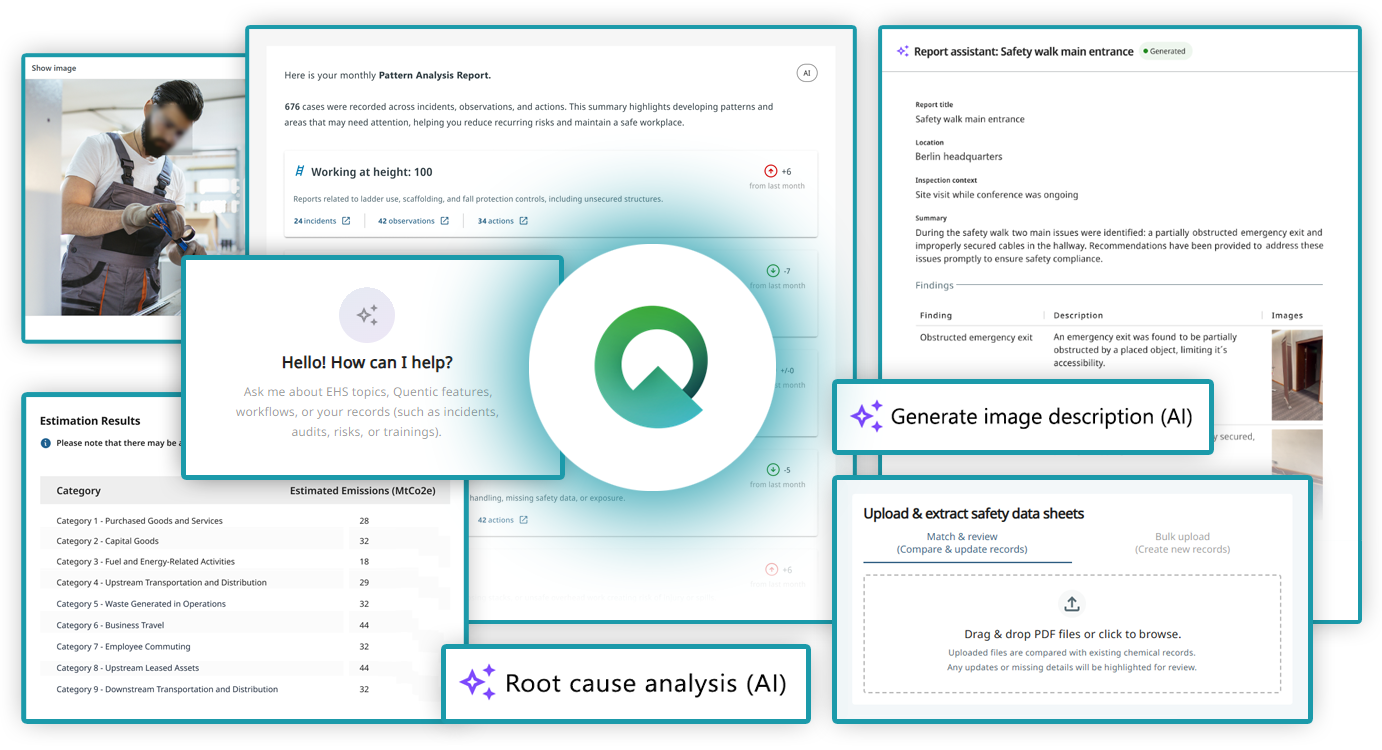
Quentic’s AI capabilities are modular and seamlessly integrated. Depending on your needs, you can access EHS AI tools across the entire Quentic Core application as well as specialized Quentic software modules. The Quentic AI portfolio is continuously evolving. Take a look at our key AI use cases in this concise overview:
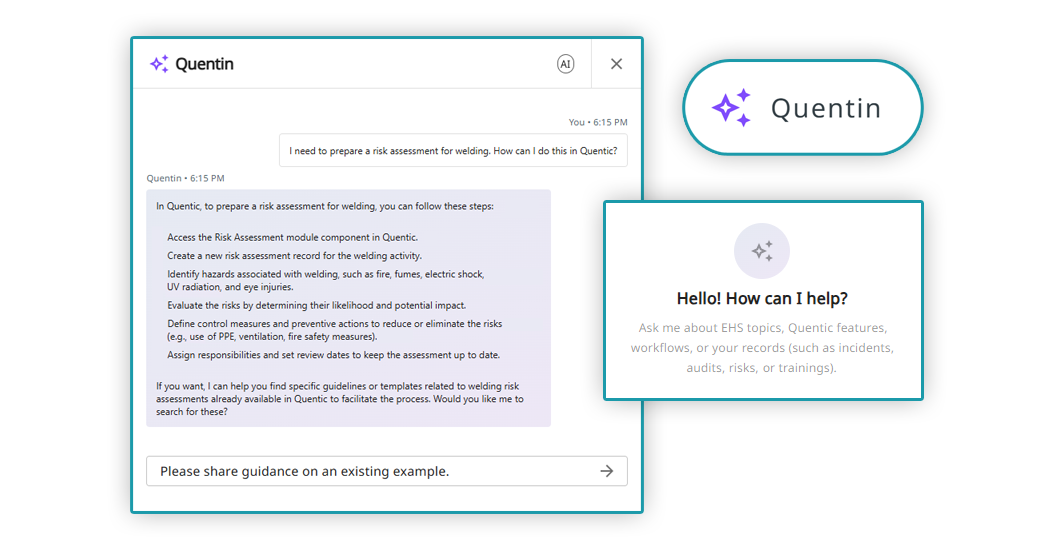
Quentin: your Quentic agent
Always by your side whenever you need smart support: Quentin, your Quentic agent. He has the right answer to any question you might have about using the Quentic software. Get to know new features easier or search your company’s own Quentic database for specific information. Need a reference from last year for your current task? Just have a quick chat with Quentin.
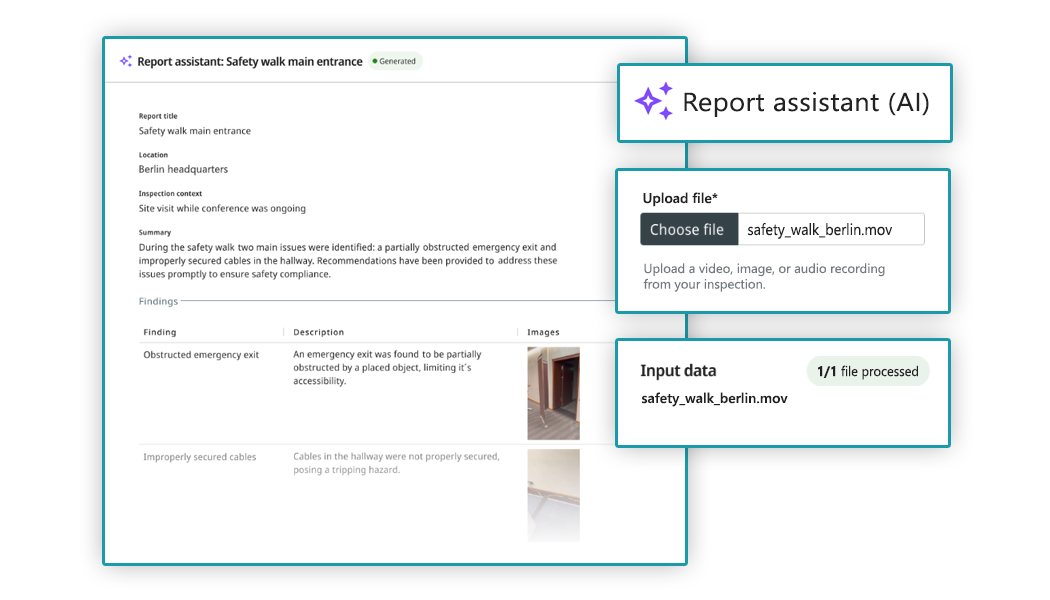
Report assistant
Make safety and compliance reporting easier with AI. The Quentic report assistant automatically pulls relevant information from your photos and videos – including voice recordings – and turns it into a structured summary of what matters most. Your puzzle pieces become a complete report within minutes, and mobile‑supported walkthroughs become your new best practice.
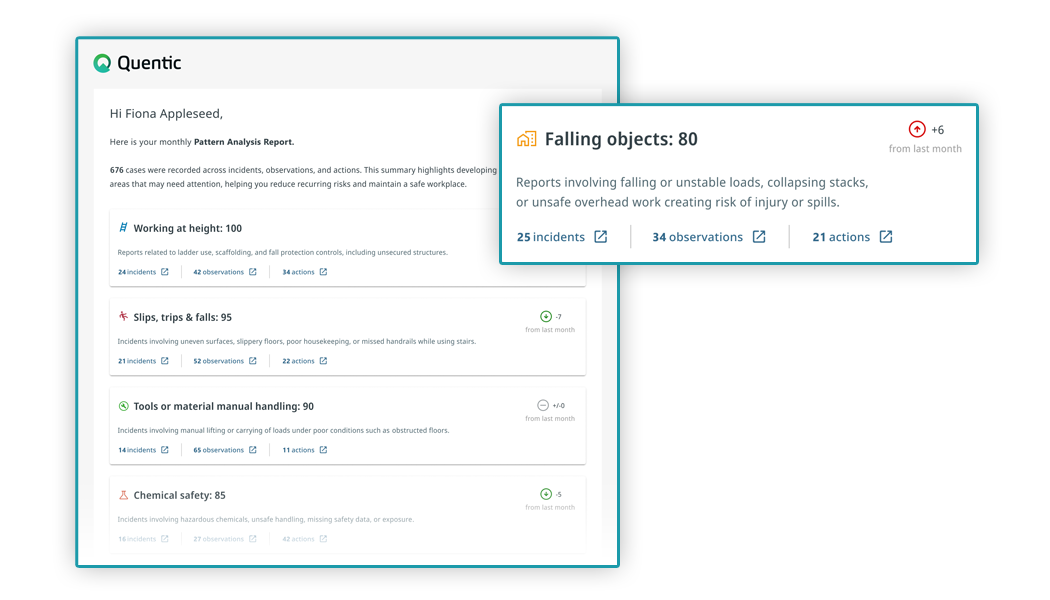
Case & pattern analysis
Quentic AI sees every detail and the big picture. Let it regularly scan your incident reports to identify correlations, trends, and hotspots in a categorical breakdown. The analyses reveal influencing factors and patterns behind incidents, accidents, and other events early on, empowering you to proactively develop preventive measures.
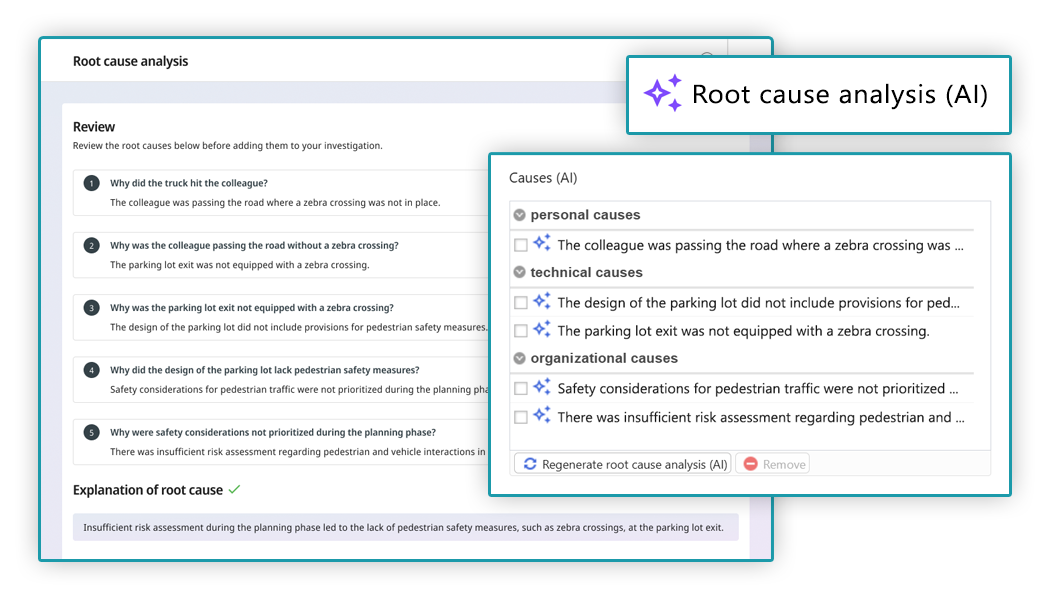
5‑why analysis
A structured Quentic workflow guides you through the 5‑why chain when processing incidents, helping you uncover underlying triggers and causes. Receive suggestions for descriptions, follow‑up questions, and answers based on your existing data. This saves time during input and ensures a reliable, consistent investigation approach across your entire organization.
Extracting safety data sheets
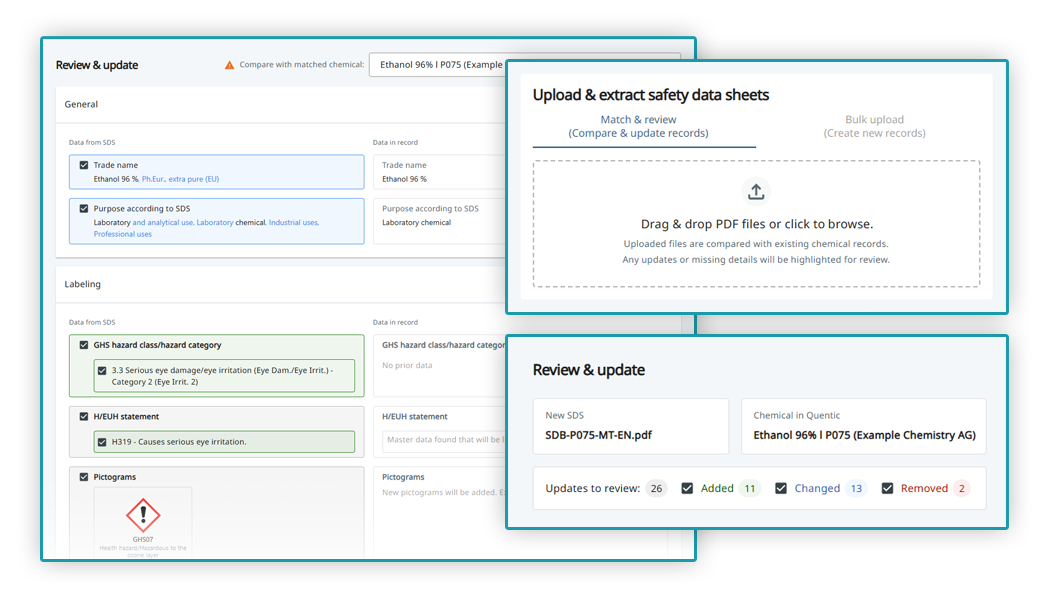
Convert large volumes of safety data sheets (SDSs) and SDS updates into your EHS system with a few clicks. Our AI extracts information from various SDS formats and languages automatically. This way, you keep essential hazardous substance information up to date at all times – while saving up to 90% of your working time.
Content‑based question lists
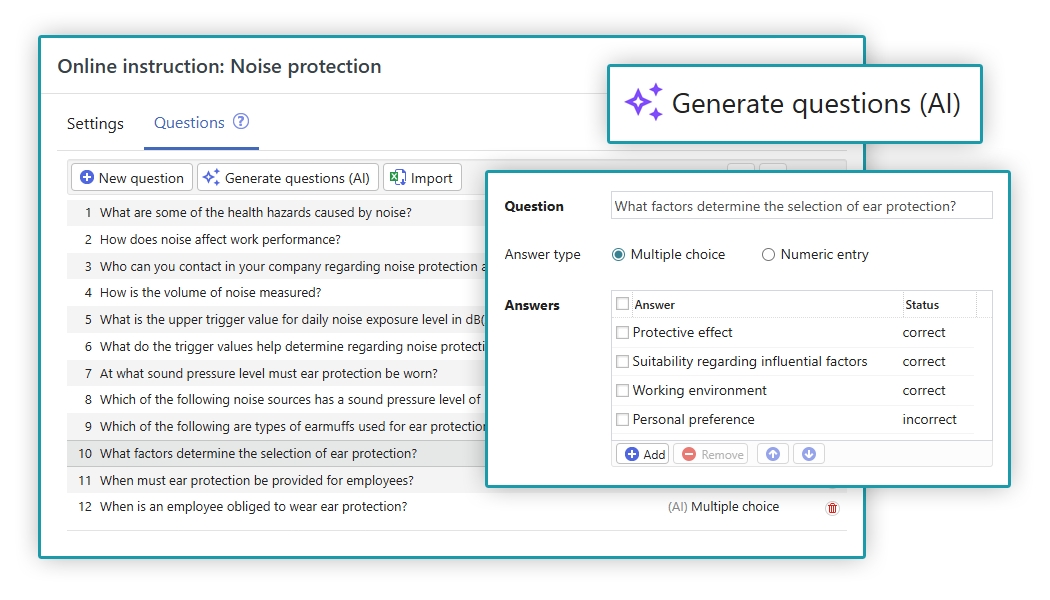
With Quentic, you can provide your team with online training on occupational safety and more. When setting up learning assessments, you receive smart support, too. The AI assistant generates a set of comprehension questions tailored to your training content, allowing you to evaluate acquired competencies.
On‑demand translation
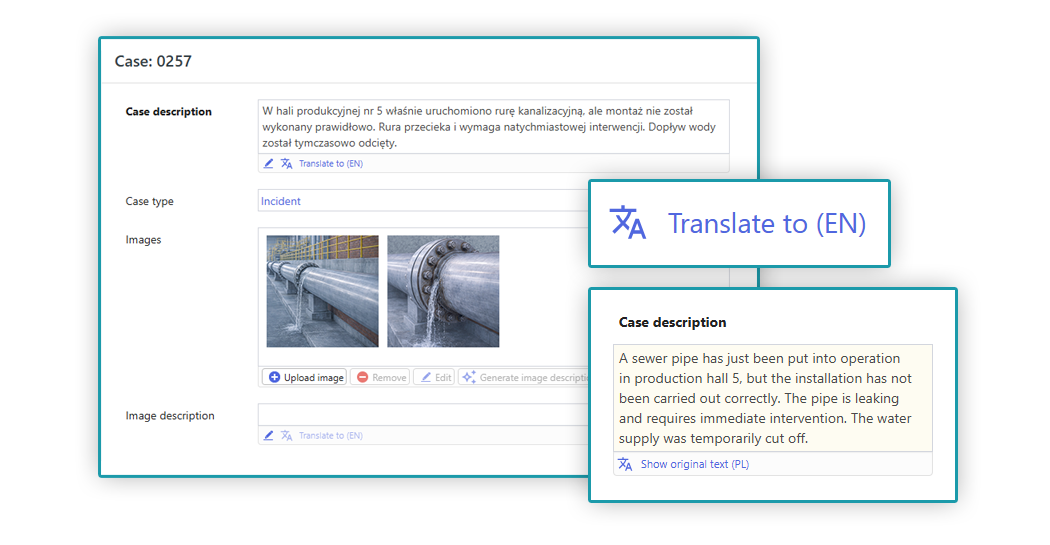
A strong safety culture thrives on participation. Involve your entire workforce in an intuitive reporting process by allowing incidents and observations to be recorded directly in their native language. This lowers barriers and expands your valuable database. Those responsible for case processing can generate an immediate AI-powered translation into their own language in the central system.
On‑demand summary
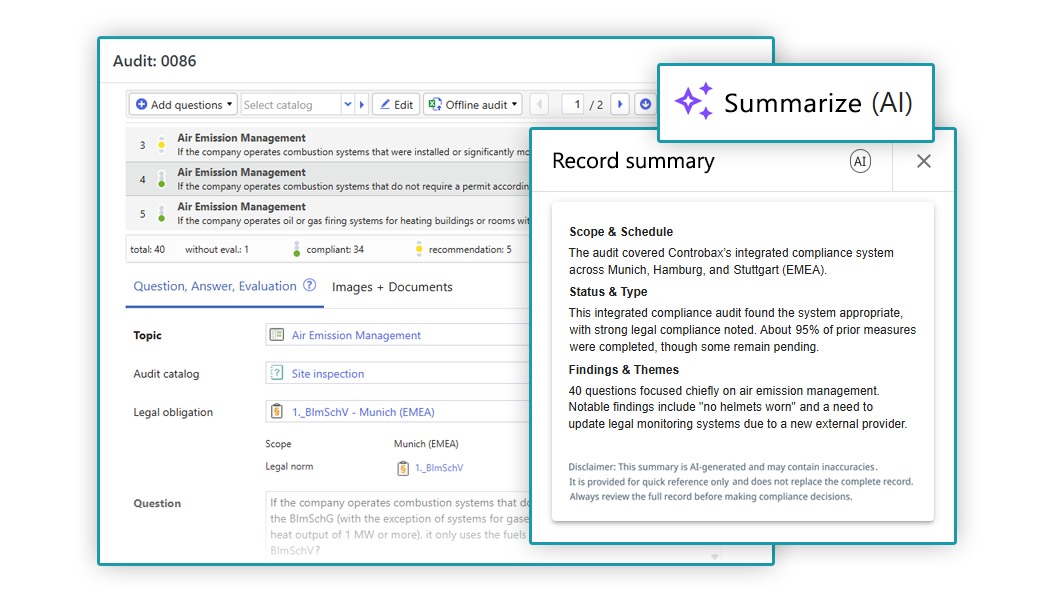
Are you short on time and need to quickly understand a specific issue? Quentic AI helps you get up to speed fast. With just one click, you receive a concise summary per data record – for example, per legal obligation, audit, or action. This gives you a clear impression of what matters before you explore selected details deeper through Quentic’s structured data forms.
Face blurring
If necessary, you can enforce strict rules regarding the display of people in your Quentic system. Quentic AI detects human faces during image uploads and automatically blurs them. This anonymizes photographs, protects personal rights, and ensures your organization’s compliance.
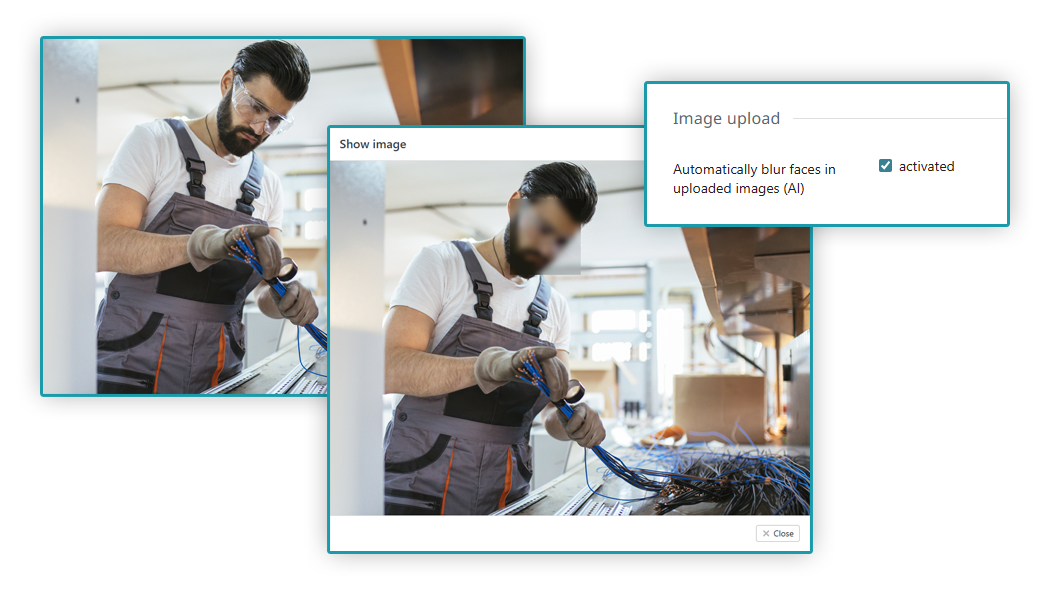
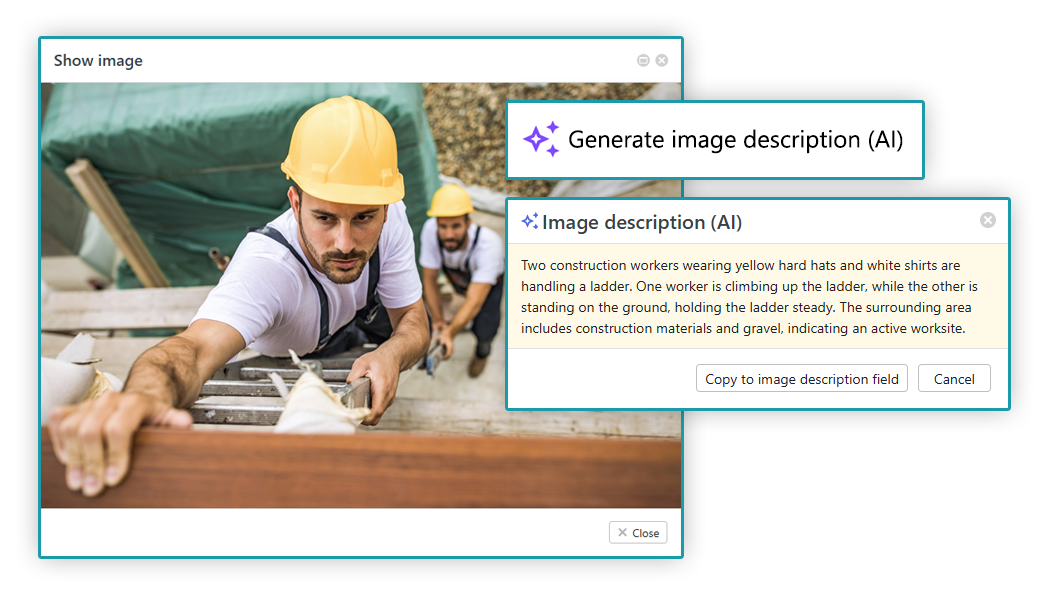
Image descriptions
Images often speak for themselves, but additional descriptions in your EHS database can provide essential clues to others. They also improve accessibility and searchability via text search. Use Quentic AI to generate clear image descriptions and manually add your own comments, if needed.
“Together with [Quentic’s] AI roadmap, these updates support automated, scalable EHS processes that eliminate EHS bottlenecks, including time-intensive documentation and inconsistent reporting, while aligning with broader organizational pressures around compliance, workforce constraints and proactive risk management.”
Brittany Sayers, Senior Analyst, Verdantix
FAQ: Quentic AI
Occupational safety, environmental management, and sustainability are highly regulated fields with extensive requirements for documentation, assessment, communication, and disclosure. A wide range of tasks and stakeholders must be managed internally and externally. To act strategically, measurable targets and KPIs are essential.
Corresponding data collections for EHS and ESG must be well structured and properly maintained. AI in EHS offers enormous potential to speed up data capture, enhance existing data, and unlock its full informational value. Beyond automating processes and saving valuable time for specialists, AI enables entirely new insights and a shift from reactive to proactive approaches – especially in risk management.
Quentic is a cloud-based, all-in-one solution for EHS and sustainability, and its integrated AI capabilities are purpose‑built for these use cases. For example, you can extract key information from safety data sheets with a simple file upload, analyze inspection videos for safety issues, or accelerate root cause analyses with pre-filled suggestions. The Quentic team places strong emphasis on developing and integrating EHS AI features and will continue to roll out more capabilities and innovations.
Quentic is a modular software platform that you can tailor to your needs. You can add AI-enabled functionality either to the core system features or to individual software modules. Each module covers a specific EHS or sustainability domain – for example, hazardous chemicals management. We are happy to advise you whether you are implementing Quentic for the first time or expanding your existing system.
Quentic’s EHS AI features are integrated directly into the Quentic user interface and require no specialized knowledge. Depending on the use case, you can trigger standardized, automated processes with a single click and receive results instantly. In other situations, you interact with an AI assistant – for example, when navigating legal topics through simple question‑and‑answer dialogue. You can also activate central system settings to receive recurring reports conveniently by email.
Identifiable customer data, prompts, and outputs are not used to train or fine-tune AI models. This is a hard requirement in our AI governance. We reserve the right to use aggregated or anonymized data to improve our services. Where we use third-party AI infrastructure, we contractually and technically ensure that your data is excluded from any model training. Your data is never shared with or made accessible to other customers or external parties for model improvement purposes.
The Quentic team develops AI features using a combination of advanced language and logic models as well as specialized models for minor tasks such as audio transcription, translation, object detection, embeddings, and classification. For our model infrastructure, we rely on Azure AI, which provides granular control over deployment regions and data processing. This also includes specially trained and fine‑tuned models.
Yes. If required, you can deactivate all or selected AI features that are technically available in your Quentic system at any time. Quentic administrators can manage the relevant settings via a centralized AI control panel – ensuring your organization always retains full control over whether and which AI functions are used. Using AI is not a prerequisite for working with the Quentic Platform.
Quentic occupies both key roles under the EU AI Act: as a provider of AI features built into our platform, and as a deployer of AI tools in our own operations. We take both sets of obligations seriously. Our AI governance framework includes risk classification for every AI feature, structured development lifecycle requirements aligned with the Act’s provider obligations, and documented deployer controls for internal AI use. We have had prohibited-practice safeguards and AI literacy requirements in place since early 2025, in line with the Act’s first implementation phase.
Every AI feature in Quentic is designed with human oversight built in from the start. By default, AI in our platform suggests, summarizes, and accelerates – it does not make final decisions on your behalf. Where customers choose to configure automated actions, this is an explicit, controlled decision within their system – not something that happens without their knowledge. For safety-critical outputs such as hazard classifications, compliance assessments, or corrective action recommendations, Quentic’s AI provides supporting information that qualified professionals review and approve. This is not just a product principle – it is embedded in our governance policies and reflects our understanding that in EHS, the consequences of an unchecked AI error can be serious.
AI systems can generate outputs that sound confident but are factually wrong – a well-known phenomenon sometimes called hallucination. In an EHS context, this is not a minor inconvenience; it can be a safety risk. Quentic addresses this at multiple levels. Our AI features are designed to work within your dedicated Quentic environment, using your structured data as the primary input rather than relying solely on general-purpose models. Whenever AI generates suggestions or drafts, our platform clearly indicates which content is AI-generated, so users can apply appropriate scrutiny. Our governance requires that AI outputs involving safety, compliance, or regulatory content are verified against authoritative sources – not just checked for plausibility.
We use a risk-based approach aligned with the EU AI Act’s framework. Every AI feature in the Quentic Platform is classified early on during the design phase. Classification considers the type of data processed, the potential impact on end users, and any regulatory obligations that apply. Higher-risk features receive more rigorous oversight, documentation, and testing requirements. This tiered approach ensures that governance is proportionate: lightweight where the risk is low, rigorous where it matters most.
In the software interface, you can always clearly recognize which features are AI‑powered. We believe users should always know when they are interacting with AI, what data the AI is working with, and which steps in a process are automated. We are building Transparency Notes for our AI features – documentation that explains in plain language what each feature does, what data it uses, what its limitations are, and how human oversight is maintained. This reflects both our regulatory obligations under the EU AI Act and our belief that transparency is a prerequisite for trust – especially in regulated industries.
Yes. Quentic maintains a structured AI governance framework designed to be auditable. Our governance documentation is layered: a strategic framework with regulatory compliance mappings for auditors and leadership, and separate operational policies for day-to-day use. We maintain registries for approved internal AI tools and product AI features, each with documented risk classifications. Our existing ISO 27001 and ISO 9001 certifications provide the management system foundation, and our AI governance is designed for future alignment with ISO/IEC 42001, the international standard for AI management systems. We are happy to discuss our governance approach in detail during the procurement process.
For AI features within the Quentic Platform, our AI infrastructure is hosted on Azure AI, giving us control over deployment regions and data processing locations. AI processing of customer data occurs within the Quentic hosting environment and is not shared with other customers or external parties. We document data residency and processing locations for our product AI features, and for customers with specific data sovereignty requirements, we can provide detailed information about where and how AI processing takes place as part of the contracting process.
Quentic EHS & sustainability software
Combine the modules you want to create the solution you need.
Product





Modules & topics
 Health & Safety Identify, evaluate, and minimize occupational risks
 Hazardous Chemicals Full control of hazardous chemicals and materials
 Incidents & Observations More insights for an excellent EHS culture
 Online Instructions Train employees and external staff flexibly
 Environmental Management Track resources and costs in real time
 Processes Streamline workflows and create clarity
 Occupational Health Preventive health care that drives compliance
 Risks & Audits The best preparation for all certifications
 Legal Compliance Better legal protection, reduced liability
 Control of Work Assess and safely organize work processes
 Sustainability Manage reporting and programs efficiently
 Quentic Core Control actions and documents