What is ESG?
The acronym “ESG” stands for environmental, social and (corporate) governance. These three aspects cover the areas of responsibility in which companies should strive to operate in accordance with specific criteria. In the financial sector, ESG criteria and corresponding KPIs are also used as investment criteria to ensure that investments are as sustainable as possible.
Strictly speaking, “sustainable” is not an entirely accurate term in this context, as ESG and sustainability are two separate and distinct concepts. In a wider context, the term “sustainability” describes an overarching concept of future-conscious practices that aims to create a balance between resource consumption and renewal without burdening or disadvantaging generations to come. By contrast, ESG specifically focuses on financial aspects and helps prospective investors pinpoint ecologically and socially responsible investments. ESG criteria therefore make it easier for responsible-minded investors to find suitable financial products. However, as ESG-compliant investments are generally in line with the concept of sustainability, the two terms are often used synonymously.
ESG and CSR in sustainability management
Comprehensive sustainability management includes strategies and measures that help companies to make a substantial contribution to the United Nations’ Sustainable Development Goals (SDGs). Two terms crop up particularly frequently in this context: CSR (Corporate Social Responsibility) and ESG (Environment, Social and Corporate Governance). Both terms relate to companies’ responsibilities but, although related, have distinct meanings and focuses. While the acronym CSR describes a rather normative concept that holds companies accountable for their social engagement from an ethical perspective, ESG helps to measure and quantify these efforts. ESG primarily refers to the sustainability assessment of listed companies in the field of green finance and sustainable investments, but has recently also been applied to sustainability management, as a whole.
What are ESG criteria?
More precisely, ESG criteria are investment criteria that make it possible to examine the sustainability credentials of various financial products. They have become a de facto industry standard for sustainable investments. However, no universal classification system has been drawn up to date, which has led to different systems being used in parallel. Nevertheless, consensus on a standardized, universal set of criteria is already within sight. Back in 2006, a UN initiative called Principles of Responsible Investment formulated six key aspirational principles. In 2020, the EU introduced the EU taxonomy for sustainable activities, followed by the EU Taxonomy Climate Delegated Act in April 2021 as part of its aim to create a standardized, pan-European system for sustainable products. The EU taxonomy also includes a Sustainable Finance Package aimed explicitly at the financial sector. This could make it possible to define strict legal requirements, which would in turn add transparency to the issue of ESG compliance.
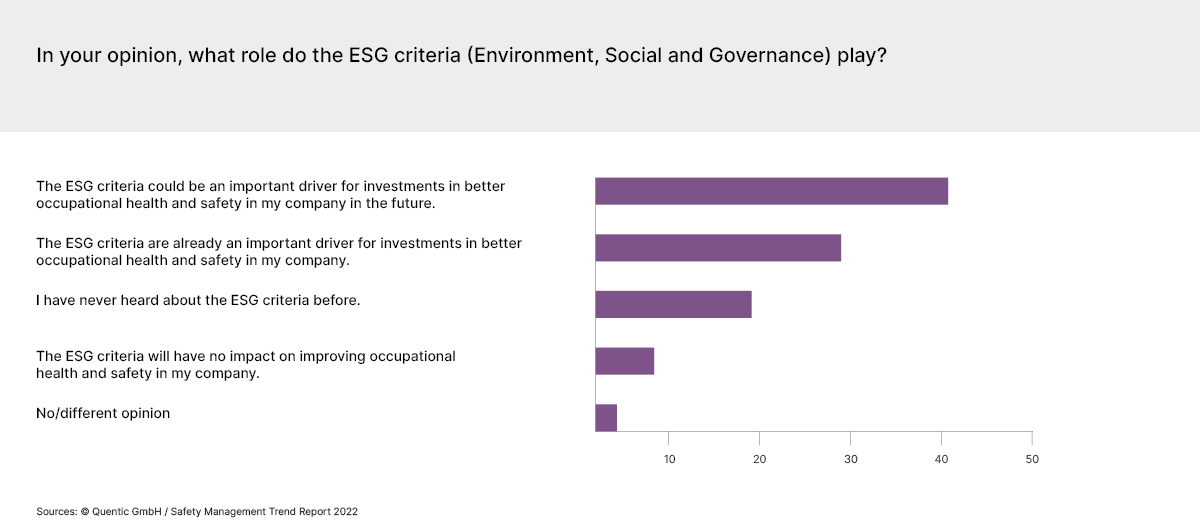
One of the most commonly used environmental criteria is an organization’s climate impact or contribution to climate protection. Meanwhile, the social aspect of ESG is increasingly shining a light on occupational safety, and efforts to improve corporate governance are the focus of the new law on supply chains. However, as noted previously, there are no specific criteria that organizations are obligated to meet. No fixed, universal ESG criteria have been formulated to date, which sometimes results in uneven requirements that vary from sector to sector. In addition, different types of businesses focus on different ESG metrics and KPIs.
ESG at a glance
Environment
Implications
- Protecting the environment
- Conserving resources
- Using renewable energy
- Working in a future-conscious way
Commonly used criteria
- Climate protection
- Resource management
- Water management
- Energy & emissions management
- Building management
Social
Implications
- Safeguarding human rights & dignity
- Eradicating child labor & slavery
- Taking responsibility for employee well-being
Commonly used criteria
- Occupational health & safety
- Health & well-being
- CPD for employees
- Supply chain audits
- (Inter)national cooperation
Governance
Implications
- Shouldering a fair share of one’s social responsibility
- Ethical business management
- Combating corruption/anti-competitive behavior
Commonly used criteria
- Compliance
- Supervision, management & control structures
- Reputation management
- Diversity