
Professional woman working focused at a desktop computer in a bright office

Beyond the spreadsheet: 5 signs your manual EHS is holding your business back

Spreadsheets may feel familiar - but they often hide the true cost of manual EHS management. Explore five signs your current approach is limiting efficiency, insight, and business value.

6 minutes06/05/2026

Spreadsheets are familiar. Flexible. Easy to start. And for many Environmental, Health, and Safety (EHS) teams, they’ve been the backbone of daily operations for years. But familiarity can hide real cost. 

Across industries, organisations are working tirelessly to keep people safe, stay compliant, and meet rising expectations, often while fighting for budget and recognition. Too often, EHS is viewed as a pure cost centre. A necessary obligation. Something that just needs to be “good enough.” 

That assumption comes at a price. 

Manual, spreadsheet based EHS systems create hidden financial and operational drag, quietly limiting efficiency, insight, and impact. Here are five clear signs your current approach may be preventing your business from unlocking significant additional benefits. 
Sign #1: Inability to derive insights from EHS data due to manual tasks

Spreadsheets can hold data, but they don’t help you understand it. 

When EHS teams spend significant time on manual tasks like data entry, consolidation, and version control, insight becomes an afterthought. Reports are backward-looking. Trends take too long to surface. Risks are identified late, not early. 

Instead of using EHS data to guide decisions, teams are stuck maintaining it. 

The result is lost opportunity: fewer preventative actions, slower responses, and limited visibility into what’s really happening across the organisation. 

When insight depends on manual effort, it rarely arrives when you need it most. 

Sign #2: Your distributed workforce creates even more manual effort

Today’s workforce is spread across sites, regions, and roles. EHS systems need to work wherever work happens.

Spreadsheets don’t.

Capturing inspections, incidents, or observations across a distributed workforce often means emails, re‑keying data, and inconsistent records. Information comes in late, or not at all. Follow-ups stall. Visibility is fragmented.

Each additional site or team adds more manual work for EHS, along with more risk.

When your tools don’t scale with your workforce, complexity increases and control decreases.

Sign #3: Employees and managers aren’t actively adopting or contributing to your safety culture

A strong safety culture depends on participation, not policing. But manual systems make engagement hard.

When reporting hazards or near misses feels time-consuming, people stop contributing. When managers don’t have clear visibility into EHS activity, safety becomes secondary to other priorities.

Over time, responsibility falls back onto the EHS function alone. That weakens culture, limits learning, and reduces ownership across the business. And no spreadsheet can change behaviour on its own.

If your EHS tools don’t invite participation, they quietly undermine the safety culture you’re trying to build.

Sign #4: Increasing complexity and task frequency cause delays across EHS processes

EHS requirements are growing, not shrinking. More regulations. More audits. More reporting. More internal expectations.

Manual systems struggle under that pressure. Tasks multiply. Deadlines slip. Audits take longer and cost more. Compliance becomes reactive instead of embedded.

Instead of enabling progress, spreadsheets create bottlenecks. When EHS complexity increases but your tools stay the same, delays become unavoidable, and expensive.

Sign #5: Incident management is reactive and time-consuming

When incidents occur, speed, clarity, and follow-through matter.

But with spreadsheet-based systems, incident management is often slow and fragmented. Information is scattered. Root cause analysis takes longer than it should. Corrective actions are tracked manually, if at all.

The focus stays on recording what happened, not preventing it from happening again.

Without a connected, automated approach, organisations stay locked in reaction mode, addressing symptoms instead of reducing risk long-term.

The real cost of staying with spreadsheets

Spreadsheets may feel harmless, but over time, they quietly limit performance and visibility across the business. 

Manual EHS systems create hidden costs that show up in lost productivity, delayed action, and missed opportunities. Time spent on data entry replaces time spent on prevention. Delayed insights increase risk exposure. Disconnected processes drive up audit costs, insurance premiums, and indirect incident costs that rarely get traced back to the root cause. 

What looks like a low-cost approach is often anything but. 

When EHS data can’t be trusted, accessed easily, or used proactively, the impact spreads well beyond the EHS function. Leadership decisions are made with partial information. Managers react instead of anticipating. Employees disengage when safety feels like administration instead of shared responsibility.

Where modern EHS delivers real business value

The opportunity cost of manual EHS is significant, but so is the upside of doing it differently. 

With a modern, automated EHS platform, organisations unlock benefits across the business, including: 

  • Productivity uplift by removing manual data handling and repetitive reporting 
  • Lower operating expenses through reduced audit effort, fewer incidents, and faster corrective actions 
  • Improved cost control across insurance premiums, risk provisions, and indirect incident costs 
  • Stronger people outcomes, from reduced turnover to safer, more engaged employees 
  • Operational continuity, supporting inventory control, production efficiency, and energy savings 
  • Brand and intangible value, protecting reputation, trust, and long-term resilience 

These gains don’t sit in one line item. They show up across P&L, operating cash flow, and intangible assets, where leadership cares most.

This is where EHS evolves from a perceived cost centre into a business enabling, value‑creating function.

From data management to trusted advisor

EHS teams already play a vital role. The difference is the tools behind them.

With Quentic, organisations move beyond spreadsheets and fragmented systems to a connected, transparent EHS platform that supports insight driven decisions. Automation replaces manual work. Data becomes actionable. And EHS leaders gain the visibility they need to guide the business, not just report on it.

That shift changes the conversation.

EHS becomes a trusted advisor. A driver of performance. A partner in protecting people, operations, and long-term value.

Take the next step: assess the cost of your current approach

If spreadsheets are still at the heart of your EHS processes, the biggest cost may be the one you haven’t measured yet.

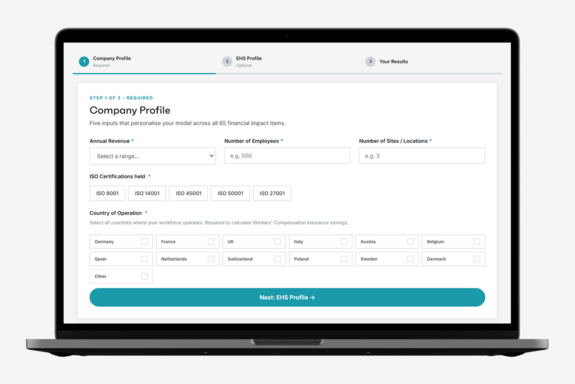
To help you uncover it, we’ve created a practical worksheet designed to help you assess whether your current EHS management approach is quietly costing your business time, money, and opportunity.

Download the worksheet to understand where manual EHS is holding you back - and where modernization can deliver the greatest business impact.

X