Defining the challenges
First and foremost, you’ll want to define the EHS-related challenges that your organization faces. Regardless of which industry you’re operating in, you will have both generic and specific challenges, which can create risks of small, medium or high magnitude for your organization. These risks can disrupt your routine operations or impact you strategically and failure to account for these risks can impact your operations with anything from a mild disturbance to a huge legal dispute.
Repercussions could affect not just your organization as a whole, but also the larger public. Not only that, but if you fail to follow the obligatory legal compliance statutes in place where your organization operates, you could face financial penalties. Strategically, your organization’s reputation will suffer short- or long-term damage, which will cast a shadow over relationships with all key stakeholders. But, most importantly, the challenges that you’re unaware of, or those that could have been overcome by consistent monitoring, could lead to fatalities.
Discovering the right solution
Obviously, it’s essential that you deploy the right resources to monitor and resolve EHSQ-related challenges, such as a state-of-the-art EHSQ software. Some of the key areas that can be addressed through EHSQ software are:
- Health & Safety: Prevent incidents, assess and mitigate risks, and provide guidance through online instructions
- Risk & Audit Management: Clearly set objectives for your programs, consider all aspects of risks, audit all levels internally, and align with external stakeholders
- Legal Compliance: Maintain legal register, handle inspections, manage changes, initiate regular content updates
- Register of Hazardous Substances: Workflow-oriented approval process, fully compliant chemical management, tracking of application and storage areas, dangerous goods management
- Air, Water & Waste management: Environmental reporting, sustainability reporting
- Control of Work: Managing work permits, safeguards, etc.
Moreover, as with many new technologies, an EHS solution can provide additional benefits:
- Rich and proven user experience
- Fully integrated modules with an all-in-one platform
- Smart reporting on-the-go
- High-performing Customer Success and Consulting Services teams
- Flexibility to adapt to requirements
- Cloud-based, easy updates and very low maintenance requirements
- ISO certified management systems, etc.
Assessing value
Along with defining your organization’s potential EHSQ challenges and considering OSHA’s hazard categories, such as Biological, Chemical, Ergonomic, Physical, and Safety, it’s essential to also assess the value that a EHS solution will bring to your organization by resolving hazards, monitoring proactively, and preventing problems at early stages.
Ideal “to-be” scenario
Although assessing the value a EHSQ solution can bring to your organization is complicated, I’ll attempt to describe generic value drivers that could help fuel your thought process:
- Based on the specific challenge and respective hazard identified, it’s obvious that your organization has certain expectations for what an EHSQ solution should deliver. Tracing the high-level requirements of the solution can be your first driver.
- The breadth of functions and the solution’s capability to address and mitigate the risks.
- The ability to keep your organization’s reputation intact, without damages incurred due to the hazards that we discussed earlier, both in the short and long term.
- Not only the product itself, but also the level of services and warranties that the EHSQ solution vendor can provide.
- The levels of trust and confidence in mutual success the EHSQ solution vendor inspires.
Now that we’ve looked at the value drivers, we’ll draft the business and technical requirements. The EHSQ solution vendor can work with you to determine the cost of the respective solution, including implementation. This first step (let’s call it “New Solution Cost”) will create the estimated total cost of your new EHSQ solution, including the value that it will add.
Factual “as-is” scenario
Beyond understanding the new solution cost, it’s important to understand the financial consequence to the whole investment. Note that, like the value drivers, financial consequences can be different for different organizations.
It’s very important to understand the cost of the systems and processes you have in place today (Excel or any other standard solution). You should also consider the costs of having no solution.
Quantify the issues you’re facing with current systems and processes. Don’t just consider Total Cost of Ownership of such systems. Also note the impact of:
- Incidents you’re unable to manage
- Situations which made your organization vulnerable due to non-compliance
- Low engagement and higher employee attrition due to the risks that employees could face
- Ad-hoc scenarios leading to hazards
- Inability to bring your products to market on schedule due to these issues
- Unhappy customers who are wary of buying from a risk-prone organization
- Competition having an advantage due to a lack of ability to compete effectively in the market
- All the negative numbers you accounted so far due to these issues
Through this step (let’s call it “Expected Savings”), we’ll have total costs of your current systems and processes, including the issues quantified monetarily. Thus, we can derive the savings that you’ll realize during the operational Ideal “To-Be” Scenario.
But the calculations don’t end here!
Crunching the numbers
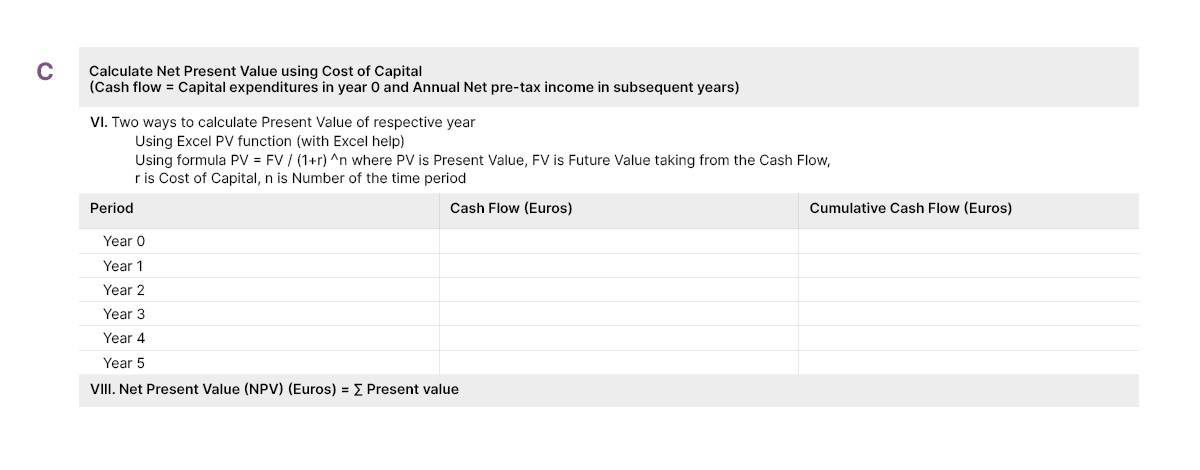
Considering the numbers from the above “As-Is” and “To-Be” scenarios, the next step is to have an in-depth look at the long-term cash flow. Consider a time frame such as Year 0 to Year 5, where in Year 0 you consider all the capital expenditures that may be needed and from Year 1 on you consider the net pre-tax income (which is subtracting your new solution cost from expected savings). Knowing the % cost of capital and applying it to the cash flow over a five-year term, you can determine the net present value of the project for the whole term.
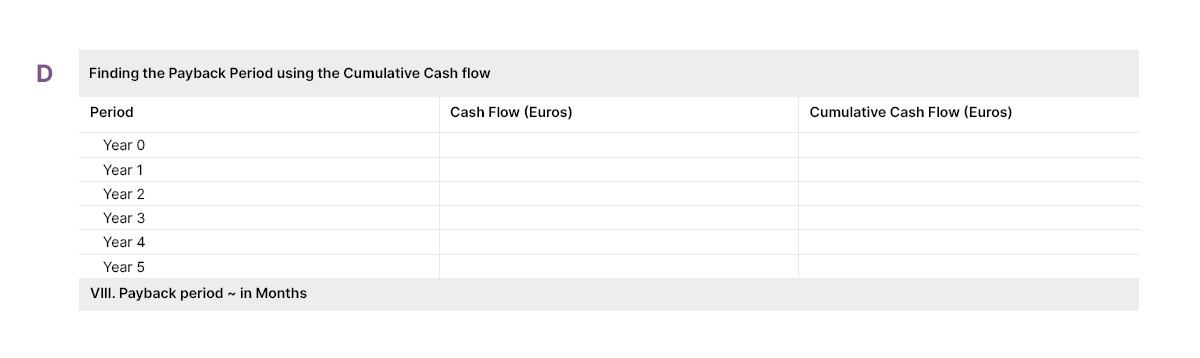
To determine the period where the investment’s benefits exceed the cost during the whole term of 5 years, you can calculate the payback period and indicated months. And, you can derive the percentage of ROI by considering the net pre-tax income for the 5-year term divided by the total cost of the project throughout the whole term.
I know this swirl of calculations may seem confusing. But, in practice, knowing the numbers and having a clear breakdown of steps will make the evaluation process much simpler. For increased clarity on the calculations, here’s a rough template with details for the respective steps: